
Geometry review can document wall thickness, draft, ribs, bosses, gate location, ejection and cosmetic-zone risks before mold steel.
Review
These cases explain buyer risk, tooling decisions and sample approval checkpoints without exposing confidential customer details.
Each anonymized case is written around the evidence a buyer should ask for: starting input, risk, engineering decision and release gate.
Review
Sampling
Material
Quality
| Evidence buyer can request | Best used when | Decision it supports |
|---|---|---|
| Marked DFM screenshots or notes | Before tooling deposit | Whether the part is ready for mold quotation |
| T1 issue and correction tracker | After first samples | Whether to correct, retest or release production |
| FAI, CMM or dimensional report | Tolerance-sensitive parts | Whether critical dimensions match drawing intent |
| Material certificate and batch notes | Engineering resin or compliance-sensitive jobs | Whether production uses the agreed resin route |
A useful case is not a photo gallery. It should show the starting file state, main risk, engineering decision and release gate.
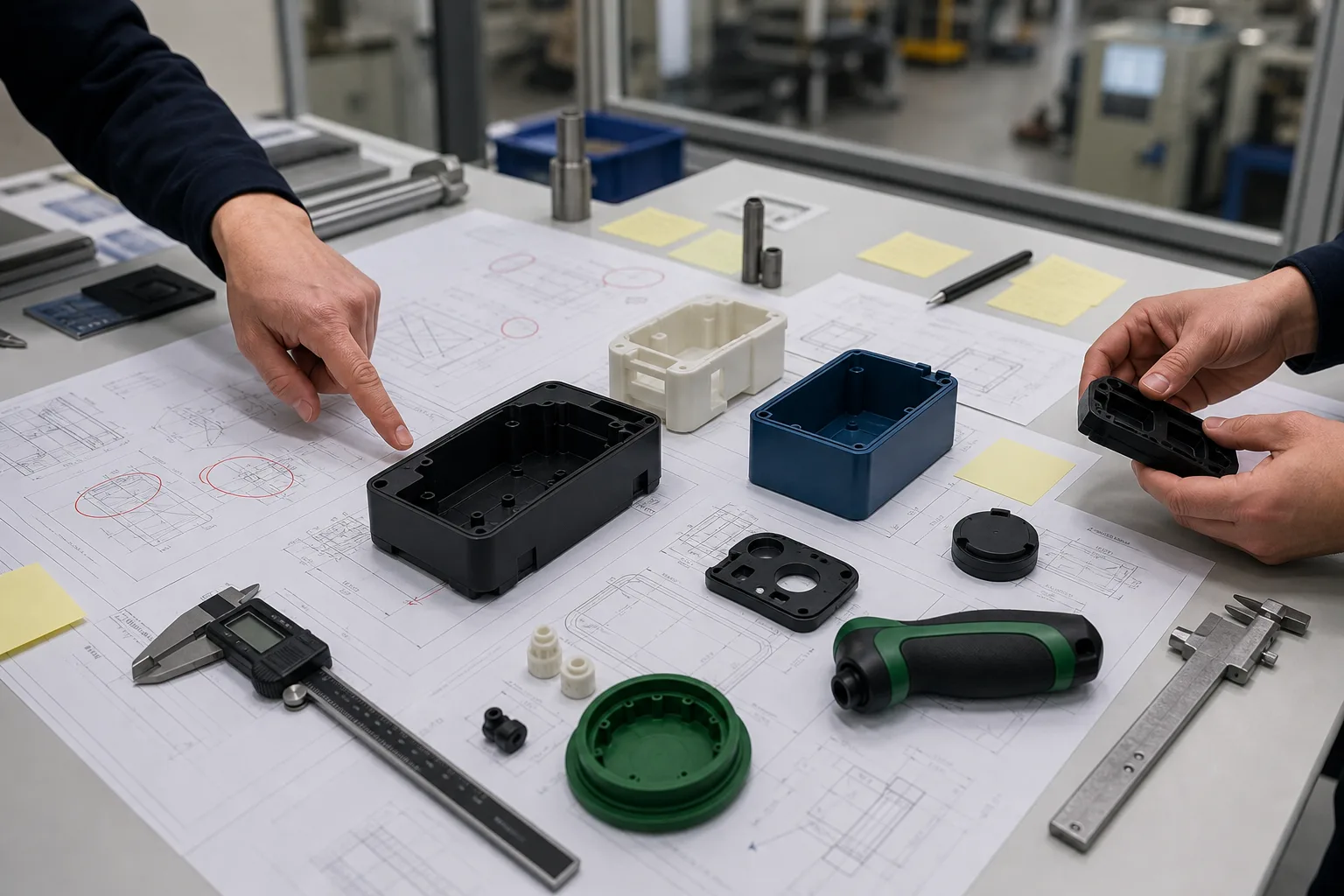
Representative review visuals are placed so verified T1 sample photos can replace them later without changing the page structure.
Rib sink, screw boss strength and parting line exposure were reviewed before mold steel was cut.
A cap project needed bridge quantities before committing to a multi-cavity production mold.
A threaded insert part needed pull-out strength without creating sink around bosses.
A clear cover required gate and polish decisions that would not leave obvious optical defects.
A soft-touch grip needed a mechanical lock reviewed before assuming chemical bonding alone would hold the TPE to the substrate.
A load-bearing mounting bracket needed rib and boss strength confirmed against long-term creep before committing to a single-cavity production mold.
A molded tray needed to fit inside an existing outer carton, so cavity-to-cavity repeatability mattered as much as the part geometry itself.
When verified customer-safe photos are available, each case should record inputs, risk, decision, evidence and commercial gate.
| Case field | What to document |
|---|---|
| Starting input | CAD, drawing, sample photo, defect photo or supplier issue note. |
| Risk found | The specific geometry, material, tooling or quality issue that could change cost or lead time. |
| Decision made | DFM change, tooling route, material decision, T1 correction or quality-document scope. |
| Evidence attached | Marked screenshots, T1 photos, dimensional report, material certificate or packing record. |
| Buyer outcome | What became clearer before deposit, T1 approval or production release. |
The case library is designed to explain common decision patterns without exposing customer files. Each example should help a buyer understand what to prepare and what evidence to request.
| Case element | Buyer value |
|---|---|
| Starting input | Clarifies whether the project began from CAD, drawings, sample photos or an existing supplier issue. |
| Main risk | Connects the case to common manufacturing concerns such as sink marks, insert retention, sealing, transparent-part cosmetics or T1 approval. |
| Engineering decision | Shows how DFM, tooling route, material choice or inspection scope changed the practical manufacturing path. |
| Release evidence | Explains what proof helped the buyer decide whether to correct, retest or start production. |